Bond’s infiltration and capture at the Castle of Death
You Only Live TwiceBond’s infiltration of the Castle of Death on the Island turns on a sequence of apparent openings that conceal increasingly dangerous traps. He enters the castle cautiously, only to be caught by a pivoting floor and delivered into the hands of Ernst Stavro Blofeld and Irma Bunt. The capture exposes both Bond’s vulnerability and the proximity of his targets: he has found them, but has lost the advantage of surprise.
The Approach and the First Trap
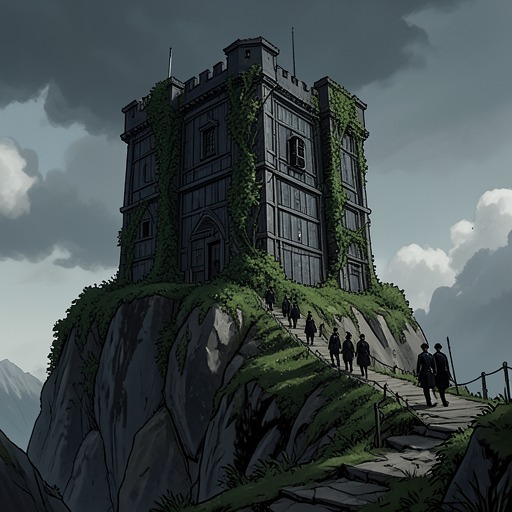
At nine o’clock, Bond leaves his hideout and follows the route he had taken the previous night. Under the moon, he sees the castle’s enormous, bat-winged donjon and notices that the Warning balloon is tethered to a pole on the balustrade around the apparent central floor. Yellow light shows through several windows there, leading him to choose that level as his target. He crosses the gravel without incident and reaches a small entrance beneath a wooden bridge.
Bond uses a small steel file to cut a link in the chain securing the door. To soften the rasp of metal, he pauses to spit into the deepening groove; when the link finally parts, he uses the file as a lever to open it. The first step beyond the doorway would have brought his foot down on a man-trap: rusty iron jaws about a yard across, partly hidden beneath straw. The danger is immediate but avoidable. Bond skirts it, recognizing that the entrance may be only the first of several concealed defenses, and proceeds with his senses on alert.
Through the Cellar
The doorway leads into a vast underground cellar, its rough stone floor and arched pillars barely visible in the narrow beam of Bond’s flashlight. Bats flit through the darkness, and their shrill cries mark his progress as he moves carefully toward a staircase. He counts twenty stone steps before reaching the entrance above. The route carries him from the castle’s hidden depths into its interior, but the care that has kept him clear of the jaws below does not protect him from the more elaborate mechanism farther inside.
A later passage seems almost inviting by comparison: it is empty, about twenty feet long, dimly lit by a central oil lamp, and floored with polished boards. Bond tests the possibility that the boards might betray footsteps, but the guard’s earlier passage has produced no warning creak. Music comes from the door at the far end—Wagner’s Ride of the Valkyries—and Bond treats it as useful cover. The quiet, apparently unguarded corridor encourages him forward while directing his attention away from what lies beneath it.
The Oubliette Trap
There is no warning when Bond steps across the exact midpoint of the passage. The entire length of flooring swivels silently on a central axis, tipping him into a black void. Only as he falls does he understand the guard’s earlier activity behind the door: the guard had been adjusting the lever that set the Oubliette trap. An alarm bell sounds as the mechanism is triggered, and the platform swings back into position above Bond. He strikes the bottom of the shaft and loses consciousness.
The trap reverses the apparent terms of the approach. Bond has treated the silent passage as a route toward his target; instead, its deceptive plainness has carried him directly into a prepared capture. The first trap offered a visible danger that could be avoided once found. The Oubliette trap conceals both its mechanism and its trigger until Bond has crossed the decisive point, leaving no opportunity to recover his footing or retreat.
Capture and Recognition
Bond regains consciousness in the straw-covered oubliette under a guard’s repeated blows. Still disoriented, he mistakes the straw in his hands for awabis and momentarily calls for Kissy Suzuki. As awareness returns, he understands that the mission has gone wrong and re-establishes the identity he must perform: a deaf and mute Japanese miner from Fukuoka. Naked apart from his black cotton ninja underpants, bleeding, and in pain, he bows and adopts a blank expression while Kono threatens him with a small automatic. He follows the guard out of the cell.
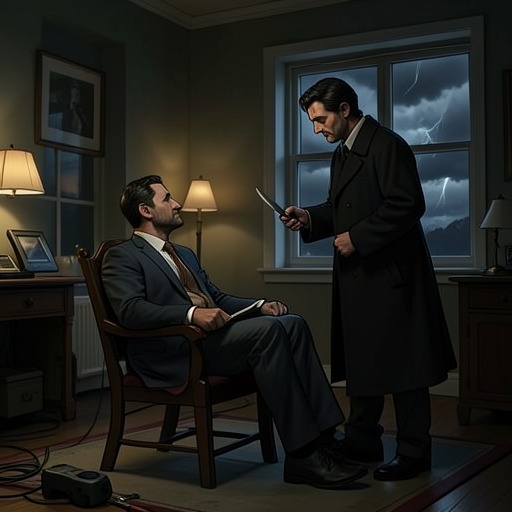
In a small library-like room, another guard lays out Bond’s ninja suit and the incriminating contents of its concealed pockets. The exposure of his equipment makes plain that the castle’s occupants have not merely detained an unknown intruder: they have his disguise and tools before them. Ernst Stavro Blofeld stands by a smouldering Japanese brazier in a black silk kimono decorated with a golden dragon. Bond recognizes him, including the white hair and heavy moustache grown for the assumed identity of Monsieur le Comte de Bleuville. Irma Bunt sits nearby in Japanese dress, and Bond recognizes her as well. Their presence confirms that the search has brought him within reach of both targets, but his single error has placed them in control of the encounter. The capture therefore ends not with a failed discovery, but with a perilous reversal: Bond has located Blofeld and Bunt, and they have captured him before he can act.